


By Sarah Newell
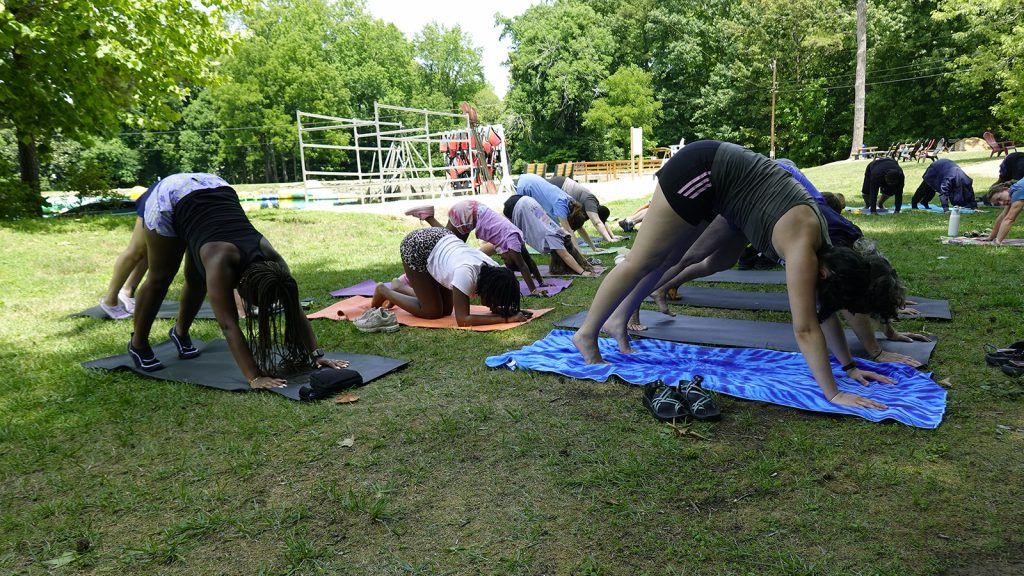
For one week of the summer, about a dozen kids gather on the outskirts of Greensboro at Piney Lake. They canoe. They swim. They jump on a giant water trampoline. They act in plays and do yoga and crafts and explore nature. And they talk about their stutter and learning to accept it.
Camp SpeakaLot hosts kids who stutter and are ages 7 to 17 at the annual summer camp. This year, there were 15 campers ages 8 to 14. The camp is run by 10 of UNCG’s Communication Sciences and Disorders graduate students, with professors Erin Leventhal and Kelly Harrington supervising.
“This is my second year,” said camper Bryson Schlein, 14. “I did a few stuttering studies to control it, but it didn’t work.”
The camp doesn’t try to make the kids not stutter. Instead, it does Acceptance and Commitment Therapy (ACT), which is more often used in psychology. It focuses on acceptance of stuttering and building resilience and strength in themselves as communicators.
The camp is stutter-affirming. It takes the focus off being fluent. When you focus on other skills, speech will be more spontaneous.
Professor Erin Leventhal, camp supervisor
The camp also aims to help kids not let their stutter play such a central role in their lives.
“We teach them not to let it have so much power over them,” Harrington said. “Choose what matters, do what matters. Don’t let stuttering get in your way. We teach campers to feel the moment and be present, to understand their feelings, to cope better with their unhelpful thoughts.”
Each day of camp is focused on one of the principles of ACT, such as “let it be” and “let it go.” For that day’s activities, the campers made glitter bottles, picking the color dye and glitter for the bottles, and then swirling them around and letting their thoughts go and settle on the bottom. They also wrote an unhelpful thought on a rock and tossed it into Piney Lake. The graduate students plan each day’s activities.
Vivian Henderson, 8, also attended the camp for the second time this year.
“I liked it the last time and wanted to come back,” she said. “I learned to let it go. I kept doing that after camp.”
Emily Vinton, one of the graduate students at Camp SpeakaLot, said it has been a learning experience for her, as well.
“We give (campers) as much time as they need to say what they want to say,” she said, adding that she’s learned to let things go, too.
Vinton said she realized the planned schedule for the day wasn’t something she needed to stick to, because being in the moment with the campers was more important.
In addition to creating the daily activities, the graduate students also gathered data on the kids and teens they’re assigned to work with, created a report for that individual for the week, conducted an evaluation, and held conferences with the parents at the end of camp regarding that person’s individual strengths and where they grew.
Vinton said this experience helped her explore a possible career path.
I would love to work with kids who stutter and help them find their voice.
Emily Vinton, graduate student
Fellow grad student Deshonte McBride said all plans for activities were submitted to Leventhal and Harrington at the beginning of June, then edited. She and her teaching partner came up with Simon Says, a Weather Wheel game relating to emotions, and Thought Bubbles regarding their thoughts on stuttering, among others.
“I’m glad I taught the first day, so I can just enjoy camp the rest of the time,” McBride said. “I’m tired by the end of the day.”
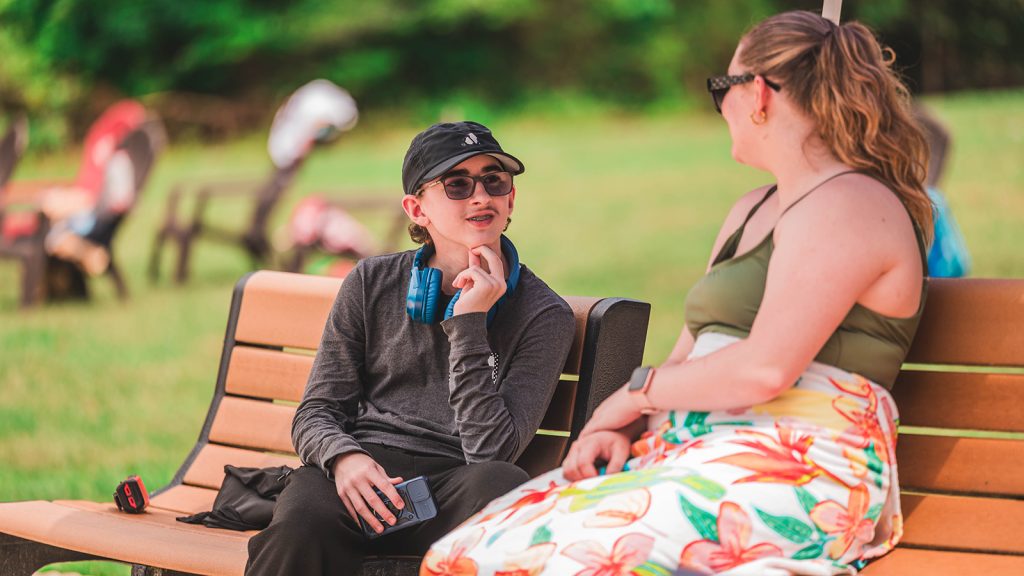
In addition to activities run by the graduate students, a daily guest speaker also talked to the campers. The individuals were all adults who stutter, and the campers could ask them questions. One included UNCG alumnus and soccer player Damon Youmans, 27. He now lives in the Charlotte area, where he teaches and coaches soccer.
One camper wondered how stuttering made his life different. Youmans remembers going to a restaurant for his birthday and instead of saying what he wanted, just pointing to it on the menu.
“I replay that in my mind, to make sure I never go back,” he said. “I’m someone with a voice. I use that voice, and you can, too.”
Youmans also told the campers that it is what they think of themselves that matters.
“When you’re younger, you want to be accepted by your friends and classmates. But it doesn’t really matter what people think of your stutter, because at the end of the day, we’re the ones who have to go through it,” he said. “The best thing I learned was to stop worrying what people thought about my stutter, and your mindset will shift dramatically.”
Harrington said a main goal of the camp is to let the kids have fun doing yoga, journaling, and nature activities, while exposing them to ACT.
“This is often the first time the kids have done this type of therapy, and also the first time they’ve been around other people who stutter. It (stuttering) can feel very isolating,” Harrington said. “At camp, they get to be around other kids who stutter and it’s a safe place.”