

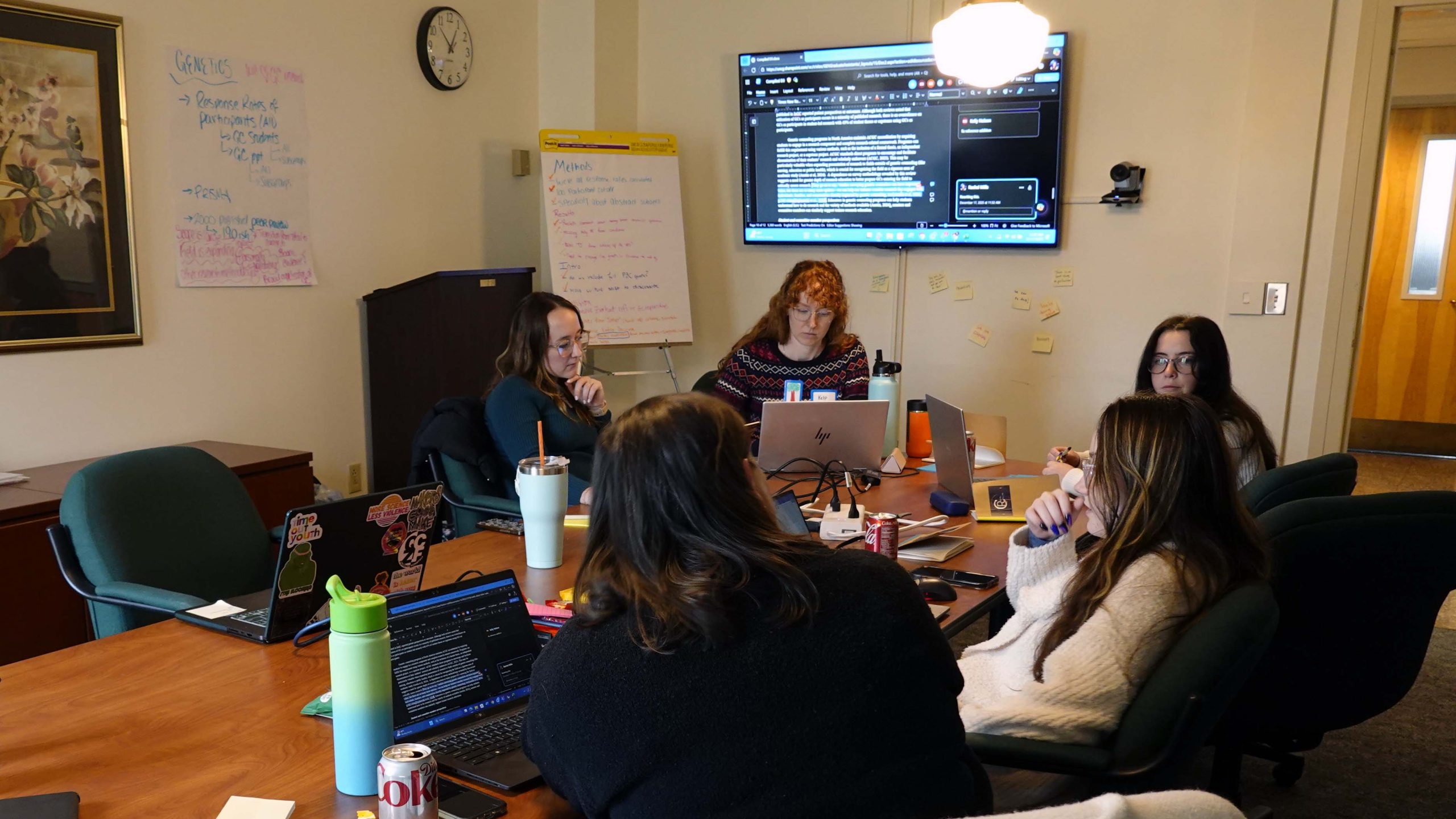
When you’re a faculty member or a student, writing a paper that will be published in a respected academic journal takes time and effort, and can be daunting. A collaborative, team approach with others interested in similar research can make the process easier, as well as more fun and engaging.
While many at UNCG were wrapping up the fall semester and resting over the winter holiday, 27 people primarily from the School of Health and Human Sciences spent three days with ReVel Collab (Research Velocity Collaborative), doing the “paper chase” method of collaborative research writing to facilitate a more productive process for a paper.
A New Method of Research Writing
“The paper chase is very different from traditional research, which is time consuming and choppy to do,” said Dr. Alicia Dahl, one of the co-founders of ReVel Collab and a professor at UNC Charlotte. “All analysis of data is completed before you start, and you know exactly what you want to do ahead of time. You use publicly available data. It doesn’t matter what the data is, as long as you know what the data are. We realized this could be a pathway for students to get involved in research.”
Dahl formed the company two years ago with Dr. Jessamyn Moxie, also a professor at UNCC. The paper chase method splits up the workload of writing a paper that will be publishable over three days. The first day is focused on writing, the second day on what’s missing from the paper, and the third day on polishing it.
Dahl, Moxie, and two of their facilitators work with the teams to ensure they can be most effective.
We set the pace for the day, do task assignments, do a strength and skills assessment and have a match assessment.
Dr. Alicia Dahl, cofounder of ReVel Collab
“We set the pace for the day; do task assignments; do a strength and skills assessment and have a match assessment; we manage the dynamics of the room and break the tension if needed; we do team building activities; we do energizers such as walks, yoga, and dance parties in the hallway; we do file management so everyone is working in the right space and content isn’t lost; and we’re the outsiders. We’re reading the article for the first time, so we ensure the translation matches what they want to say,” Dahl said.
A Team Approach with a Variety of Participants
Dr. Esther Leerkes, Associate Dean of Research for HHS, previously participated in a paper chase. She said the forced breaks at the end of a 45 to 60-minute writing block were critical.
“I didn’t want to stop writing, but I could see the quality of my writing go up after a break,” she said. “And talking and getting to know each other (in my team) in a non-threatening manner with prompts really help my team collaborate.”
UNCG’s participants were split into four groups based on their interests: Response rates among genetic counselor participants in student-led research; health care inequities for sexual and gender minority adults in the U.S.; cardiovascular risk factors among U.S. Latina women by age, education, nativity, and parental status; and the role of sleep quality and exercise on brain activity in college students. The teams included two undergrad students, eight master’s students and three Ph.D. students, in addition to faculty members and researchers.
The mix of faculty and students is intentional, including involving people who may have never done research before.
This helps build relationships with people who could mentor you and build other relationships. We play with the power dynamics so people can trust themselves, so graduate and undergraduate students feel confident.
Jessamyn Moxie, cofounder of ReVel Collab
“This helps build relationships with people who could mentor you and build other relationships,” Moxie said. “It helps navigate the fear of, ‘Is this paper done enough? Is it polished enough?’ We play with the power dynamics so people can trust themselves, so graduate and undergraduate students feel confident.”
It can also lead to students who may not have considered themselves in research as a career viewing that as a possibility.
For Kinesiology Ph.D. student YJ Seo, this was his fifth time in a paper chase.
I Learn something every time. I feel like a paper won’t be finished each time, but it works out with the writing and editing.
YJ Seo, Kinesiology Ph.D. student
“I learn something every time. I feel like a paper won’t be finished each time, but it works out with the writing and editing,” he said, adding that the experience is invaluable for a career. “Having a publication helps secure an application for graduate school or a job.”
Kinesiology professor Dr. Eric Drollette said being able to talk about ideas in a team and come up with a solution was refreshing.
It reminds me of why I got into research in the first place.
Dr. Eric Drollette, Kinesiology Professor
HHS’ Office of Research funded two teams, the Center for Women’s Health and Wellness funded a team, and the Dean’s Office funded a team, with the goal for the teams to have a paper ready to submit to a journal at the end of the three-day process. The teams were selected by faculty members and ReVel Collab, ensuring the best needs of the groups were met.
Next Steps in the Chase
At the end of three days, all four teams had completed drafts of their papers, but none were quite ready for submission. Two had manuscript drafts, group revisions, and journal submission materials that include an abstract and cover letter. Three teams plan to submit to journals in January. The fourth needs to finalize their data analysis, which they were aware of prior to the start of the paper chase.
Dahl and Moxie have a plan for teams that are ready for submission at the end of the three days.
“If a team doesn’t finish in three days, we ensure they have a plan to finish, whether it’s in a day, or they set aside blocks of time to do it,” Dahl said. “We’ll check in once a month, and we celebrate every milestone with them.”
Content is also developed, so their research and ideas aren’t lost and can be utilized later.
Kinesiology Professor Dr. Jenny Eitner was impressed with how the paper chase method expedited the writing.
“Without this, it would have been a six-month process to write the paper, and we’ve done it in a week,” she said. “The problem-solving (in a group) was also helpful. I’d love to do this every semester.”

By: Sarah Newell