

Compiled by Sarah Newell
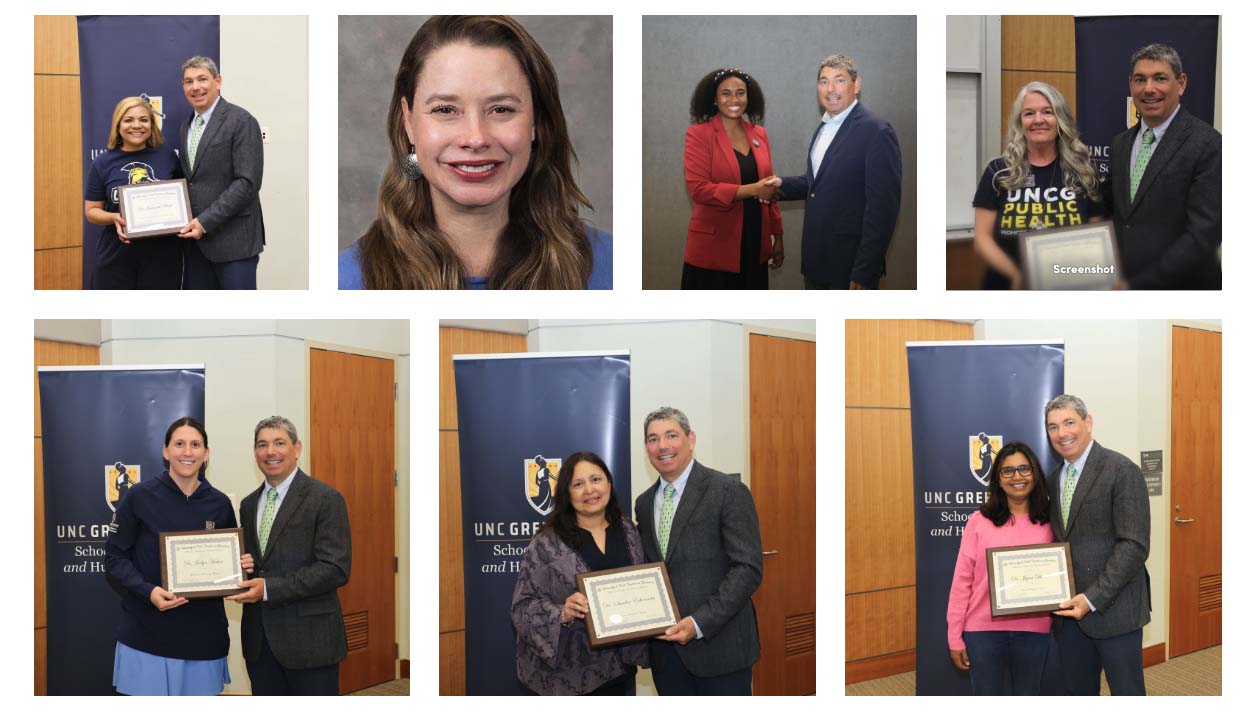
Each year the School of Health and Human Sciences recognizes outstanding faculty and staff with several awards. Please find a description of each award. Congratulations to the 2025-26 awardees.
The Mary Frances Stone Teaching Award: Dr. Jeannette Wade, Human Health Sciences Program
Dr. Jeannette Wade’s teaching is grounded in real-world application, critical inquiry and a deep commitment to her students’ academic and personal growth. From the moment students meet her, they experience her professionalism, integrity and genuine care.
Whether guiding students, challenging them to trust their own thinking or leading discussions on imposter syndrome, she creates an environment of trust, reflection and growth. She meets students where they are by encouraging quiet voices, challenging confident ones and ensuring every student has a path to engage.
Through her care, relevance and rigor, Wade prepares students not just for careers, but to be thoughtful, confident agents of change.
Jerry and Joan Morrison Tolley/Gail M. Hennis Graduate Teaching Award: Dr. Marcia Hale, Department of Peace and Conflict Studies
Dr. Marcia Hale’s work is deeply rooted in community, collaboration and real-world relevance. Her teaching goes beyond content, engaging the emotional, relational and spiritual dimensions of learning, while maintaining a strong commitment to rigor, systems thinking and social justice.
Hall creates classrooms grounded in trust and care. Through a trauma-informed approach and her “alongside” teaching stance, students are not just learners, but co-investigators. She encourages them to engage in complex topics like environmental justice, intersectionality, and global conflict with both critical insight and personal reflection.
Hall models non-violent communication and creating a space where students feel seen, supported, and encouraged to grow. One student said her mentorship is life-changing, and opened doors to opportunities like presenting at the United Nations and shaping their professional path. Hale exemplifies what it means to teach with purpose and integrity.
HHS Teaching Excellence Award: Dr. Jocelyn Smith Lee, Human Development and Family Studies
Dr. Smith Lee’s work is defined by intentionality and impact. In her courses, she incorporates high-impact practices that move students beyond memorization to deeper critical thinking and real-world application.
In her online HDF111 course, she creates meaningful engagement through structured discussion boards, “lightbulb moment” reflections and assignments that ask students to connect lifespan development to their own lives and future goals. Her classroom is grounded in inclusion and community. Students consistently note that she ensures every voice is heard.
Beyond the classroom, Smith Lee’s mentorship is transformative, providing students with research opportunities, professional development and the confidence to grow as scholars and leaders. Through intentional design, deep reflection and a genuine commitment to student success, Smith Lee exemplifies excellence in teaching.
HHS Outstanding Staff Award: Donna Myers, Department of Public Health
Donna Myers is the person who makes everything work and makes it better along the way. Through her leadership, advising in Public Health Education has become more organized, more proactive and more student‑centered. She has strengthened systems that guide students from first advising conversations to graduation, ensuring fewer missteps and more moments of clarity and confidence.
But what truly sets Myers apart is not only what she builds, but how she serves. She approaches every student and colleague with warmth, patience, and genuine care. Whether guiding a student through graduation requirements, getting students back on track, creating community‑building programs that foster belonging or fixing problems before anyone else even notices them, Myers leads with compassion and integrity.
She understands that students succeed best when they feel seen, supported and welcomed, and she makes that happen every day. Myers doesn’t seek recognition, but she has certainly earned it. Her work makes UNCG stronger, and our students’ lives better.
Graduate Mentoring: Dr. Jackie Maher, Department of Kinesiology
Dr. Jackie Maher is widely known for her innovative and hands-on approach to mentoring students across graduate programs at UNCG and beyond. She creates an environment where students succeed academically and develop as collaborative scholars.
Her mentoring is defined by creativity and impact. Through initiatives like weekly journal clubs, her “Brag Board” and the Paper Chase writing retreats, Maher provides students with meaningful opportunities to engage in research and produce publishable work. These experiences have already resulted in multiple manuscripts and significant professional growth for her students.
Her mentees have earned national and institutional recognition, reflecting both their talent and her guidance. Maher also extends opportunities beyond her own lab, fostering collaboration and expanding access to research experiences across programs.
Through her innovation, leadership and dedication to student success, Maher exemplifies excellence in graduate mentoring.
HHS Junior Research Award: Dr. Sandra Echeverria, Department of Public Health Education
Dr. Sandra Echeverria’s research program is dedicated to translating research evidence into actionable community strategies to reduce critical health disparities.
In the eight years she’s been at UNCG, Echeverria has continued to build a nationally recognized research program that examines the systems producing and sustaining cardiovascular health inequities, with particular focus on people of Latin American origin.
Her primary work investigates how immigrant factors, neighborhood contexts, built environment determinants and educational and occupational inequities shape cardiovascular risk factors including diabetes, physical activity, obesity, and smoking. Notably, this work extends beyond simply highlighting disparities by attempting to shed light on the root causes.
Echeverria has more than 70 peer-reviewed articles in premier outlets and in 2024 she was invited to write a perspective on equity-centered physical activity in the American Journal of Public Health for the first ever special issue focused on Latino health.
Echeverria’s recent work has been supported by funding from the Robert Wood Johnson Foundation and an NIH funded research center focused on diabetes care. She has a sustained record of impactful scholarship, application of advanced methods, active grant seeking efforts and inclusion of students.
HHS Senior Research Award: Dr. Jigna Dharod, Department of Nutrition
Dr. Jigna Dharod has built an internationally recognized research program focused on maternal and infant nutrition, food and water insecurity and health equity among immigrants, refugees and populations with low income. Her work spans local, national and international contexts, demonstrating both breadth and responsiveness to pressing public health needs. Given the nature of these critical topics, Dharod’s work has been published in peer-reviewed journals from several different fields, including nutrition, public health and women’s health. She is also the first UNCG faculty member to be selected as a Research Triangle International Fellow.
Her research has been funded by the Robert Wood Johnson Foundation, USDA/NIFA, NC Tracs and NIH. Dharod was one of the first HHS faculty to make the successful leap from NIH R15 funding to a large NIH grant (R01). Dharod’s current NIH R01 is a clinical trial testing the efficacy of economic incentives to support breastfeeding among low-income Latine mothers. A fascinating recent finding from Dr. Dharod’s work with high policy significance is that maternal feeding patterns, in particular overfeeding/feeding less recommended foods, varies across the WIC benefit cycle, presumably based on the food resources the family has at the time. This line of research has critical implications for obesity prevention.
Dharod’s work is distinguished by methodological rigor, interdisciplinary collaboration, mentorship and a sustained commitment to translating science into practice.